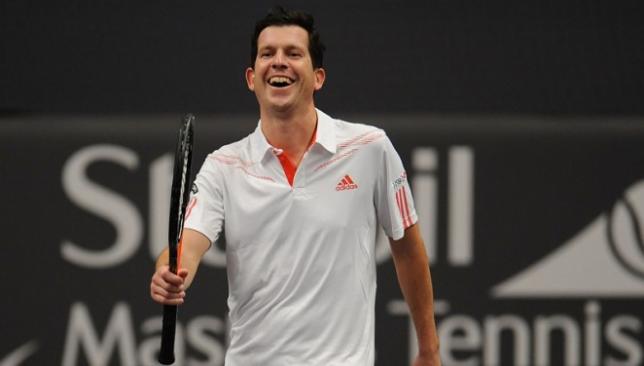
Tim Henman is the man who revitalised British tennis and gave the home crowd at Wimbledon a reason to dream each year for almost a decade at the All England Club.
In 1998, he became the first British man to reach the semi-finals at Wimbledon since the 1970s and he went on to repeat that achievement at five more Grand Slams, peaking at No4 in the world in 2002, and capturing 11 ATP singles titles before retiring in 2007.
He spent a total of 243 weeks ranked in the top-10 and had done so much for the sport in Great Britain that he had a hill unofficially named after him on the Wimbledon grounds, where thousands gathered each year to support him.
Yet to some, Henman was also the nearly man. The player who went far but never far enough. Between 1996 and 2004, every Wimbledon an entire nation pinned their hopes on him to end the British drought in the men’s tournament at SW19, and each time he fell just a little bit short.
He finished his career without reaching a final at a Grand Slam, but in his six semi-finals he had lost to the likes of Pete Sampras, Roger Federer, Lleyton Hewitt and Goran Ivanisevic – blockbuster names who have comprised a huge part of modern day tennis.
Henman may have suffered some heartache throughout his career, but six years retired, the 38-year-old declares that he has no regrets.
“I really look back on all my career with very few negative thoughts or memories,” Henman told Sport360° at the du Forum on Yas Island, where he held a coaching clinic during Summerfest Abu Dhabi.
“A few disappointments, but to have achieved what I’ve achieved was way more than I ever dreamt of when I was growing up.”
Signature pose: Henman's famous fist pump was seen plenty throughout his career.
Three of those disappointments came at Wimbledon against Sampras. The American former world No1, who ended his career with 14 Grand Slams (a record later broken by Federer) frequently practised with Henman and was a good friend of his.
But he crushed the Brit’s campaigns at SW19 in the second round in 1995, and twice in the semi-finals in 1998 and 1999. They faced off seven times in their careers, with Sampras winning all of them except the last one.
“I played some great matches against him,” Henman added. “I was happy that I did beat him in my career – unfortunately it wasn’t at Wimbledon, I beat him in Cincinnati (in 2000).
“I think the best match we played at Wimbledon was in 1998, which was my first semi-final. He won in four sets. End of the third set, when it was one-set-all, there were definitely some pretty tense moments.
“The reality was I played some great tennis and he was better than me. He won Wimbledon seven times, he’s one of the best grasscourt players ever. Just to have the opportunity to have played him was amazing.”
Henman says he still occasionally gets in touch with Sampras but he mainly catches up on his news through Paul Annacone, a mutual friend who coached both players and who is currently part of Federer’s team.
Henman explains how being Sampras’ contemporary helped him improve his game but he also credits someone else as a main motivator during his time on court. Just like Rafael Nadal concedes that he is a better player because of Federer, Henman says he found that true in his rivalry with Canadian-turned-Brit Greg Rusedski.
Domestic rivalry: Henman said Rusedski made him a better player.
He added: “I would say closest to home is probably Greg Rusedski because we were big rivals, trying to be the British No1 and pushing higher and higher in the rankings.
"When he first came from Canada, he was around 50 in the rankings, that was a good benchmark and then I overtook him and then we sort of got to top-20, then top-10 and then top-five and there’s no doubt that we made each other better players.”
Henman has certainly done well enough in his career to secure a comfortable retirement. He spends most of his time with his wife and three daughters, Rosy, Olivia and Grace, and makes the occasional appearance on the Champions Tour.
He is on the tournament board at Wimbledon, he commentates for the BBC and he plays a lot of golf, which he says is his biggest passion at the moment. Henman still follows tennis closely though and says the game has dramatically changed since the last time he took to the courts on the ATP Tour six years ago.
A classic serve-and-volleyer with an uncanny feel for the ball at the net, Henman’s playing style is close to non-existent now on tour, which has been hijacked by powerful baseliners.
When asked whether he thinks his game could survive in today’s tennis, Henman said: “Not in these conditions, no. The courts are now slower and the balls are definitely a bit heavier and that’s what makes it so difficult to serve-and-volley and come to the net because they have a little bit more time with the ball off the court.
Enjoying retirement: Henman spends his time with his family and playing golf.
“So my only criticism, or if I was to make some adjustments in the game I would try and make there a greater variation in surfaces in the conditions, because I think now the surfaces are almost the same. You don’t see people coming to the net and that’s a shame.
“But when you reflect on the spectacle now and you watch these matches – the Wimbledon final, there’s no better example – the rallies that they’re having, it is unbelievable to watch. And when you go back to maybe the late 1990s and it was having three-shot rallies if you were lucky because it was so servicedominated, I think the game is a better spectacle now.”
He says he can’t see himself as a coach, but Henman has had an influence on the career of Andy Murray. Henman mentored him early on and they are now good friends.
Since Murray’s historic win at Wimbledon last week, the question of a knighthood has arisen, and Henman concluded: “I don’t think in any way it would be a hindrance to his career. For me, he will be knighted at some stage. Whether it’s better to wait until the end of Andy’s career, who knows, but it’s a nice problem to have.”
FACTFILE
1995: Cracked the top-100 for the first time 1996: Made his first Grand Slam quarter-final at Wimbledon (lost to Todd Martin) 1997: Won his first ATP title in Sydney 1998: Reached his first of four Wimbledon semi-finals (lost to Sampras) Became a top-10 player for the first time in August. 2002: Hit his career-high ranking of No4 in July. 2003: Won first and only Masters title in Paris, beating Roger Federer and US Open champion Andy Roddick en route. 2004: Became the first Brit to make the Roland Garros semifinals in 41 years (lost to Guillermo Coria).
* For breaking news, follow us on @Sport_360 or find us on Facebook.